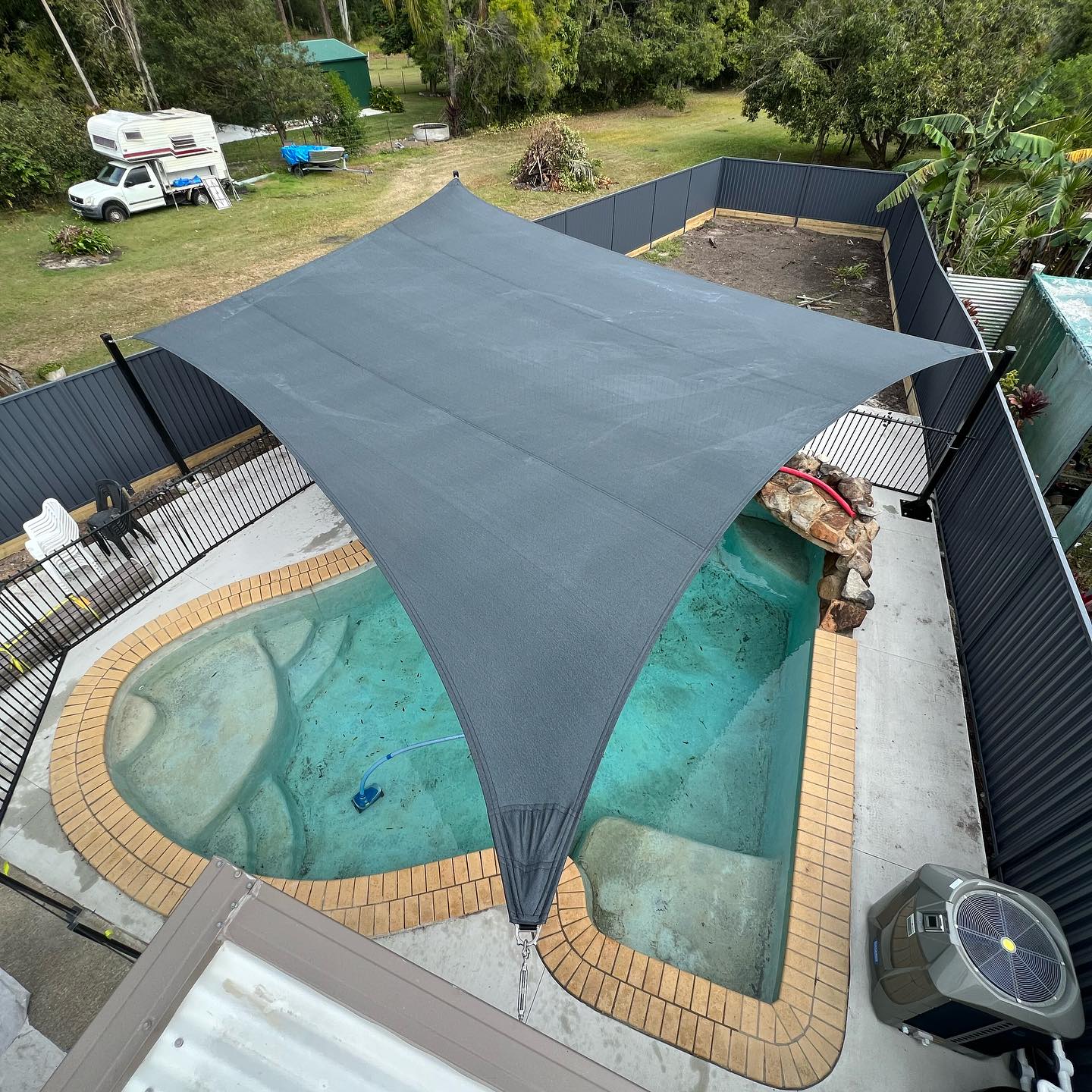
The short answer: your shade sail should extend at least 600 mm–1 m beyond each edge of your pool, and you should choose a shape that matches the footprint you need to cover. Get those two things right and you’ll have comfortable, effective shade all summer. Read on for the full sizing guide, real-world examples, and a quick-reference chart.
Why Shade Sail Size Matters for Pool Areas
Picking the right size isn’t just about aesthetics. A shade sail that’s too small leaves half your pool baking in direct sun. One that’s too large can overload your anchor points, sag in the middle, or simply look wrong over a modest backyard pool.
Sun Coverage vs. Pool Footprint: They’re Not the Same
The shadow a shade sail casts is never exactly the same size as the sail itself. Because the sun moves across the sky throughout the day, the shadow shifts too. A sail that perfectly covers your pool at noon may leave the shallow end exposed by 3 pm. That’s why you always size up from your pool’s bare dimensions.
Consequences of Going Too Small or Too Large
- Too small: Inadequate UV protection, hot spots on the water, and frustrated swimmers.
- Too large: Excess fabric tension, structural stress on posts and anchor points, and potential wind damage.
- Just right: Even shade across the pool and deck, proper tension, and a sail that lasts.
Understanding shade sail UV ratings is equally important, a correctly sized sail in a low-grade fabric can still let through harmful UV.
Measure Your Pool and the Area You Want to Cover
Before you look at a single product listing, grab a tape measure. Accurate measurements are everything.
How to Measure a Rectangular or Square Pool
Measure the longest length and the widest width of the pool shell at water level. Write both numbers down. These are your baseline dimensions, not your sail size.
How to Measure an Irregular or Freeform Pool
For kidney-shaped or freeform pools, measure the longest length and the widest width as if you were drawing a rectangle around the pool. This bounding-box method gives you the maximum footprint you need to cover.
Should You Cover Just the Pool or the Surrounding Deck Too?
Most homeowners want shade over the pool plus at least 1–2 m of the surrounding deck or coping, the area where people actually sit, stand, and dry off. Factor that extra deck space into your measurements from the start. It’s the single most common sizing mistake people make.
The Golden Rule: Add Overhang to Your Pool Dimensions
Never order a shade sail the same size as your pool. Always add overhang.
How Much Overhang Do Shade Sails Typically Need?
A minimum of 600 mm (about 2 ft) on each side is the standard starting point. For pools with adjacent deck areas or where you want shade during the late afternoon when the sun is low, aim for 1–1.5 m of overhang on each side.
Quick Sizing Formula
Sail Size = Pool Dimension + (Overhang × 2)
For example, a pool that’s 4 m wide with 1 m of overhang on each side needs a sail at least 6 m wide. Apply the same formula to the length.
Keep in mind that shade sails also need to be tensioned correctly, most manufacturers build in around 1–3% of fabric give, so your installed sail will appear slightly smaller than the listed dimension. Ordering slightly larger accounts for this.
Standard Shade Sail Sizes and What Pools They Suit
Small Shade Sails (Up to 3.6 m / 12 ft)
Best for: plunge pools, spas, above-ground pools up to about 2.4 m × 4 m, or partial deck coverage. These are easy to install with two or three anchor points and suit compact backyards.
Medium Shade Sails (3.6–4.9 m / 12–16 ft)
Best for: standard residential pools up to about 3 m × 6 m, or a pool plus a narrow deck strip. This is the most popular size range for Australian backyards.
Large Shade Sails (4.9–6 m / 16–20 ft)
Best for: pools in the 4 m × 8 m range, or a pool with a generous surrounding deck. Anchor points need to be properly engineered at this size, don’t rely on timber fence posts.
Extra-Large and Custom Shade Sails (6 m+ / 20 ft+)
Best for: large residential pools, resort-style pools, or commercial applications like a café deck or school pool area. At this scale, a custom shade sail designed for your exact layout is almost always the better investment over an off-the-shelf product.
Shade Sail Shapes and How Shape Affects Coverage
Shape is just as important as size. Each shape has trade-offs in coverage efficiency.
Triangle Shade Sails, Coverage and Sizing Tips
Triangles are the most popular shape because they’re versatile and look great. But they cover less area per metre of fabric than a rectangle or square. A 5 m × 5 m × 5 m equilateral triangle covers roughly 10.8 m², less than half the area of a 5 m × 5 m square. Use triangles for partial coverage, angled pools, or layered multi-sail setups.
Square Shade Sails, Coverage and Sizing Tips
Squares offer the most even coverage per attachment point. A 5 m × 5 m square covers 25 m², making it efficient for pools that are roughly equal in length and width. Good for square or round pools and compact rectangular pools.
Rectangle Shade Sails, Coverage and Sizing Tips
Rectangles are the natural fit for the standard rectangular pool. A 4 m × 6 m rectangle covers 24 m² and maps neatly over a pool of similar proportions. They’re the most practical choice for the majority of Australian backyard pools.
Using Multiple Shade Sails for Larger Pools
Two overlapping triangles or a triangle-plus-rectangle combination can cover a large or irregularly shaped pool more effectively than one giant sail. Overlapping by 300–500 mm eliminates gaps where direct sun sneaks through. Multiple sails also let you adjust or remove sections independently, handy in storm season.
Sun Angle and Shade Sail Positioning, Why It Changes Your Size Needs
How the Sun’s Path Affects Shadow Coverage
In Queensland and the Sunshine Coast region, the sun tracks from the north-east in the morning to the north-west in the afternoon, sitting high in the sky at midday. A sail positioned flat will cast a shadow almost directly beneath it at noon but will cast a longer, shifted shadow in the morning and afternoon. If you need shade during the hottest part of the day (10 am–3 pm), a flat or near-flat sail directly over the pool works well.
Optimal Mounting Height and Angle for Maximum Pool Shade
A slight pitch (15–20 degrees) improves water run-off and helps the sail shed wind. It also means the shadow shifts slightly toward the lower end of the sail. Mount the high point of your sail at around 3–3.5 m and the low point at 2.4–2.7 m for a good balance of shade coverage and weather performance. Higher mounting generally gives a larger shadow footprint, which is another reason to go taller with your posts if your yard allows it.
Attachment Points and Structural Considerations
How Many Posts or Anchor Points Do You Need?
- Triangle: 3 anchor points
- Square: 4 anchor points
- Rectangle: 4 anchor points (sometimes 6 for very long spans)
Each corner of the sail needs a dedicated, structurally sound anchor, a steel post set in concrete, a solid masonry wall, or an engineered bracket on an existing structure.
Spacing Between Anchor Points and Sail Size Relationship
The distance between your anchor points should match the sail’s edge length, not the overall footprint. For a 4 m × 6 m rectangle, your posts need to be positioned approximately 4 m apart on the short sides and 6 m apart on the long sides. Measure your available anchor positions first, this often determines which sail size is actually feasible in your yard.
Checking Your Yard Layout Before You Buy
Walk your yard with a tape measure and mark out potential post positions with stakes or spray paint. Check for underground services, tree roots, and overhead power lines before you commit to a size. It’s also worth checking whether your installation requires council approval, our guide on local council approval for shade sails in Australia covers what you need to know.
Real-World Sizing Examples by Pool Type
Example 1: 3.6 m × 7.3 m Rectangular Pool (12 ft × 24 ft)
Pool dimensions: 3.6 m wide × 7.3 m long. Add 1 m overhang each side: 5.6 m × 9.3 m rectangle. A 5 m × 9 m or 6 m × 9 m rectangle shade sail covers this pool and a narrow deck strip comfortably.
Example 2: 4.6 m × 9.1 m Rectangular Pool (15 ft × 30 ft)
Pool dimensions: 4.6 m wide × 9.1 m long. Add 1 m overhang: 6.6 m × 11.1 m. This is large enough that two overlapping 5 m × 6 m rectangles or a single custom sail in the 7 m × 11 m range is the right call.
Example 3: Round or Oval Pool (4.3 m / 14 ft Diameter)
Bounding box: 4.3 m × 4.3 m. Add 1 m overhang: 6.3 m × 6.3 m. A 6 m × 6 m square shade sail works well, or two 5 m equilateral triangles overlapped for a more dynamic look.
Example 4: Large Freeform Pool with Deck Area
Bounding box: 6 m × 10 m. Add 1.5 m overhang for the deck: 9 m × 13 m. At this scale, a custom-designed shade sail or a combination of two large rectangles with overlapping coverage is the practical solution. Off-the-shelf products rarely come in sizes that suit irregular large pools well.
Other Factors That Influence Which Size to Buy
Local Wind Conditions and Sail Tension
Larger sails catch more wind, which puts greater load on posts and fixings. If you’re in a coastal or exposed area, common on the Sunshine Coast, consider whether a slightly smaller sail with proper tensioning is safer than a maximum-size one. High-quality, UV-rated fabric like Rainbow Shade Z16 is engineered to handle Australian conditions, but the structure holding it still needs to be up to the task. You can read more about how shade sails perform in strong winds before deciding.
HOA Rules or Local Permits
Some councils and body corporates restrict shade sail dimensions, colours, or post heights. Check before you buy rather than after, it can save you a costly removal and reinstall.
Budget Considerations: Bigger Isn’t Always Better
A well-positioned medium sail can outperform a poorly positioned large one. If budget is a constraint, prioritise placement and quality fabric over raw size. Two well-positioned triangles can cover more usable area than one oversized rectangle mounted in the wrong spot.
Shade Sail Size Quick-Reference Chart
| Pool Size (approx.) | Recommended Sail Size | Best Shape |
|---|---|---|
| Plunge / spa (up to 2 m × 3 m) | 3 m × 4 m or 4 m triangle | Triangle or rectangle |
| Small pool (3 m × 5 m) | 5 m × 7 m rectangle | Rectangle |
| Standard pool (3.6 m × 7.3 m) | 5.5 m × 9 m rectangle | Rectangle |
| Medium pool (4.6 m × 9 m) | 6.5 m × 11 m or two 5 m × 6 m | Rectangle or dual sail |
| Round pool (4.3 m dia.) | 6 m × 6 m square | Square or two triangles |
| Large / freeform (6 m × 10 m+) | Custom design | Custom or multi-sail |
All sizes include approximately 1 m overhang per side. Adjust for deck coverage as needed.
Frequently Asked Questions
Can I use two smaller shade sails instead of one large one?
Yes, and it’s often the smarter choice. Two overlapping sails give you more flexibility in coverage, are easier to install and tension correctly, and can be removed or replaced independently. Overlap the edges by at least 300–500 mm to avoid gaps in shade.
Do shade sails shrink or stretch over time?
Quality shade cloth has minimal stretch, but cheaper fabrics can sag over time as fibres fatigue. High-grade fabrics like commercial-spec UV cloth are stabilised to hold their shape. When sizing, factor in that proper installation tension means the sail will sit slightly smaller than its listed edge length, this is normal and expected.
What if my pool is an unusual shape?
Draw a rectangle around the entire pool footprint (the bounding box method) and use that as your baseline measurement. Then add your overhang. For very irregular shapes, a custom-made shade sail cut to your specific anchor point positions will always outperform an off-the-shelf size.
How much of my pool should a shade sail cover?
Ideally, the entire pool surface plus at least 1 m of surrounding deck. Full coverage protects swimmers from UV exposure and keeps the water temperature more comfortable. If budget or yard layout limits you, prioritise covering the shallow end and the area where people enter and exit the pool.