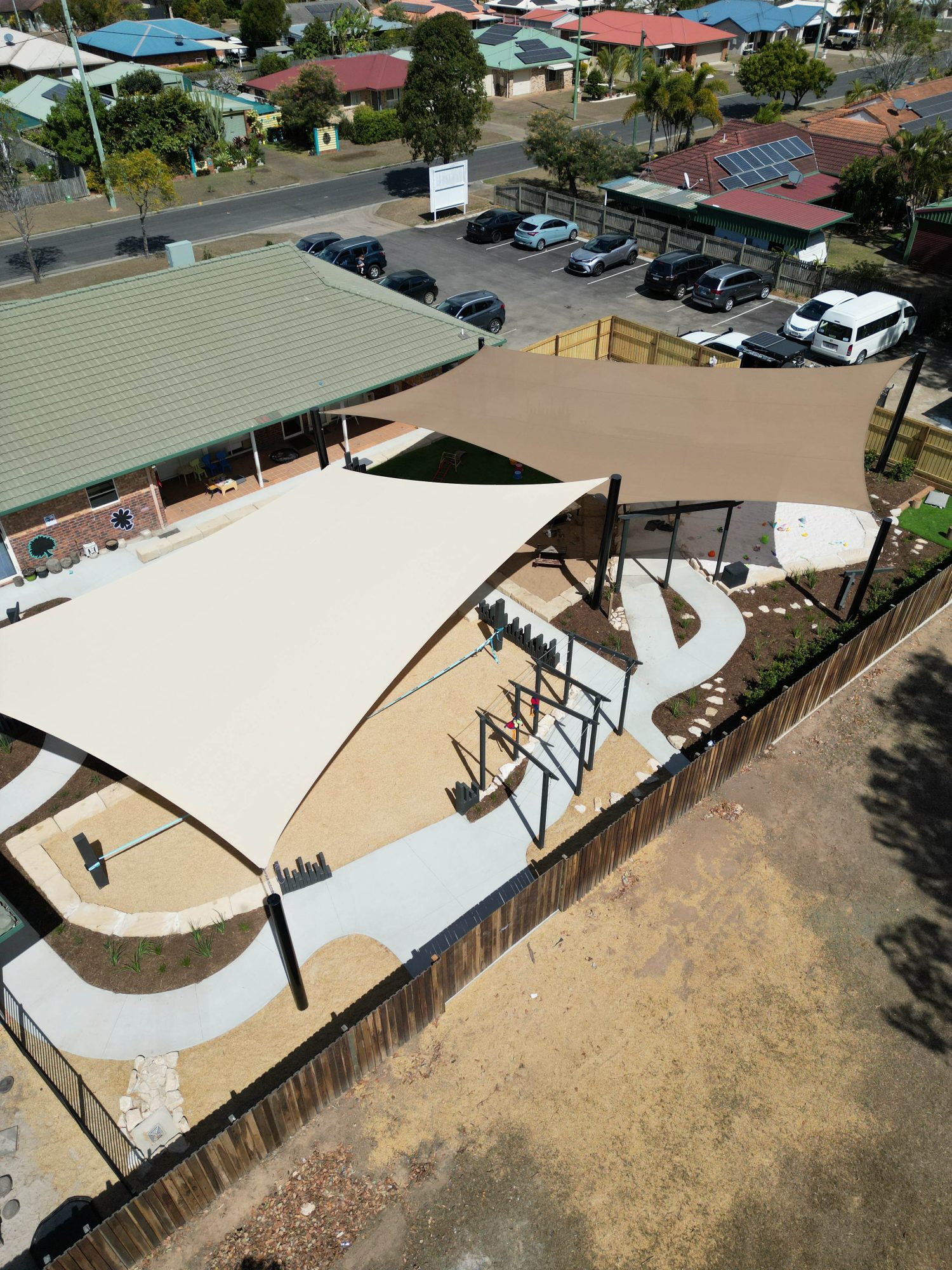
Commercial shade sails are purpose-built for high-traffic, high-responsibility environments, and choosing the wrong one for a cafe patio or school playground can mean costly replacements, compliance headaches, or worse, a liability issue. This guide cuts through the noise and gives you everything you need to make a confident, informed decision.
What Are Commercial Shade Sails?
A commercial shade sail is a tensioned fabric structure designed to cover large outdoor areas and withstand the demands of public or semi-public use. Think school playgrounds, outdoor dining areas, childcare centres, and council parks.
How Commercial Shade Sails Differ from Residential Models
The core difference comes down to engineering, materials, and scale. Residential shade sails are typically smaller, use lighter-weight fabrics, and are anchored to existing structures like fences or house eaves. Commercial shade sails are:
- Larger in span, often covering 50 m² to several hundred square metres
- Anchored to engineered steel posts set in concrete footings
- Made from heavier-duty fabrics with higher UV blockage and tensile strength
- Designed to meet Australian Standards for wind load and structural integrity
Key Features That Define a Commercial-Grade Shade Sail
- UPF 50+ rated fabric (blocks 98%+ of UV radiation)
- Stainless steel or hot-dipped galvanised hardware
- Engineer-certified post and footing systems
- Compliance with AS 4174 (shade fabric) and relevant local building codes
- Manufacturer warranties of 5–10 years on fabric and hardware
Why Cafes and Schools Need Commercial Shade Sails
The short answer: duty of care. Both cafes and schools have a legal and ethical obligation to protect people from sun exposure, and a quality shade structure is one of the most effective ways to do it.
Benefits for Outdoor Dining Areas and Cafe Patios
A well-designed shade sail transforms a sun-drenched patio into a genuinely comfortable space that customers want to linger in. That directly affects revenue.
- Extends usable outdoor seating hours across all seasons
- Reduces heat on tables and seating surfaces, improving comfort
- Protects customers from UV exposure during peak dining hours (10am–3pm)
- Adds a polished, intentional aesthetic that lifts the overall venue feel
- Can be colour-matched or branded to align with your cafe’s identity
Benefits for School Playgrounds, Courtyards, and Sports Areas
Schools in Australia, particularly in Queensland, operate under strict sun safety obligations. Shade structures over playgrounds, seating areas, and outdoor learning spaces are increasingly expected rather than optional.
- Encourages outdoor activity year-round without sun risk
- Protects students and staff during supervision and sport
- Reduces surface temperatures on play equipment by up to 20–30°C
- Supports compliance with SunSmart school accreditation guidelines
For childcare centres specifically, the requirements are even more rigorous. Our detailed post on childcare shade structures and QLD sun safety standards covers what centres need to meet current obligations.
UV Protection, Safety, and Duty-of-Care Obligations
For any commercial operator, UPF 50+ is the minimum acceptable rating. This blocks at least 98% of UV radiation. Anything below UPF 30 is not appropriate for school or childcare environments, and most councils and insurers will expect documented evidence of the fabric’s UV rating.
To understand exactly what UV ratings mean and how to read them, check out our guide on understanding shade sail UV ratings.
Types of Commercial Shade Sails
Shape Options: Triangle, Square, Rectangle, and Custom
- Triangles are versatile and great for layering in multi-sail configurations
- Squares and rectangles offer maximum coverage per unit and suit structured spaces like courtyards
- Custom shapes (hexagons, tapered sails, irregular polygons) can be designed around existing architecture, trees, or obstacles
For commercial properties, custom shapes are often the most practical option because real-world spaces rarely fit a standard template.
Single vs. Multi-Sail Configurations
A single large sail works well for a straightforward rectangular patio or play area. Multi-sail configurations, where two or more sails overlap at different heights, are popular for:
- Covering irregular or very large areas
- Creating visual interest and architectural appeal
- Allowing airflow between sails while maintaining shade coverage
Fixed vs. Retractable Shade Sails for Commercial Use
Most commercial shade sails are fixed installations, tensioned between engineered posts and left in place year-round (or seasonally removed in cyclone-prone areas). Retractable systems exist but are significantly more expensive and less common in school or cafe settings where permanence and low maintenance are priorities.
Materials and Fabric Specifications
Fabric choice is arguably the most important decision you’ll make. Get this wrong and you’ll be replacing the sail well before its time.
HDPE Knitted Fabric vs. PVC Coated Fabric
| Feature | HDPE Knitted | PVC Coated |
|---|---|---|
| Breathability | High, allows airflow | Low, traps heat underneath |
| Waterproofing | Shade-only (not waterproof) | Fully waterproof |
| Weight | Lighter | Heavier |
| UV blockage | UPF 50+ achievable | UPF 50+ achievable |
| Best for | Playgrounds, open patios | All-weather dining, covered areas |
HDPE knitted fabric (like Rainbow Shade Z16) is the most widely used option in Australian commercial settings. It’s durable, breathable, UV-rated, and available in a wide range of colours.
UV Blockage Ratings: What to Look For (UPF 50+)
Always ask for the manufacturer’s UPF test certificate. UPF 50+ is the standard you should insist on for any school, childcare, or public-facing commercial application. Some lower-cost fabrics advertise “shade” without specifying UPF, that’s a red flag.
Colour, Aesthetics, and Brand Alignment
Commercial shade sails can be manufactured in virtually any colour, which means cafes can match their brand palette and schools can use their house or team colours. Lighter colours reflect more heat; darker colours can absorb more but may offer slightly higher UV blockage depending on the weave density.
Waterproof vs. Shade-Only Fabrics: Which Is Right for You?
- Shade-only HDPE fabric: Best for playgrounds, sports areas, and patios where airflow matters. Water passes through the weave.
- Waterproof PVC fabric: Best for outdoor dining areas where you want protection from light rain, keeping tables usable in mixed weather.
Many cafes opt for a hybrid approach: waterproof sails over the core dining area and breathable sails over peripheral zones.
For a deeper dive into material choices, our guide on how to choose the best materials for your shade sails is worth reading before you commit.
Structural and Installation Considerations
Post and Anchor Systems for Commercial Installations
Commercial shade sails require purpose-engineered steel posts set in concrete footings. The post diameter, wall thickness, and footing depth are all calculated based on:
- The size and weight of the sail
- Local wind speed and exposure category
- Soil type at the installation site
Typical commercial posts range from 76mm to 168mm in diameter, with footings extending 600mm–1,500mm below ground depending on conditions.
Wind Load Ratings and Engineering Certifications
In Australia, all commercial shade structures should be designed to comply with AS/NZS 1170.2 (wind actions). This means the structure is engineered to withstand the wind loads specific to your location, coastal Sunshine Coast installations, for example, face different wind exposure than an inland site.
Ask your supplier for an engineer’s certificate or structural design report. This is not optional for schools or council-managed properties.
Council Permits and Building Compliance for Schools and Hospitality Venues
Yes, most commercial shade sail installations require a building permit or development approval. The rules vary by state and council, but as a general guide:
- Structures over a certain size (often 10 m²) require a permit
- Installations on school or childcare grounds may require additional approvals
- Heritage-listed or character properties have additional overlay rules
Our blog post on whether you need local council approval to install a shade sail in Australia covers this in detail. For Queensland-specific rules, we also have a dedicated post on council approval for shade sails in QLD.
Professional Installation vs. DIY: What’s Recommended for Commercial Settings
For commercial properties, DIY is not a realistic option. Here’s why:
- Structural engineering sign-off is required, which means certified post and footing designs
- Incorrect tensioning can cause fabric failure or structural damage
- Insurance and warranty coverage often depends on professional installation
- Council permits typically require a licensed builder or contractor to carry out the work
A professional installer handles site assessment, council permit applications, engineering certification, footing excavation, post installation, and sail tensioning, all as part of the job.
How to Choose the Right Commercial Shade Sail for Your Venue
Sizing and Coverage Area Calculations
A shade sail doesn’t cover its full stated dimensions, the usable shade footprint is typically 80–85% of the sail’s area due to the angled tensioning. For a school playground requiring 100 m² of shade, you’d need roughly 120 m² of sail area.
For multi-sail configurations, factor in 10–15% overlap at the joins to eliminate shadow gaps.
Matching Shade Sails to Your Venue Type
| Venue | Recommended Approach |
|---|---|
| Cafe / restaurant patio | Waterproof PVC or HDPE, custom shape, colour-matched to brand |
| School playground | HDPE UPF 50+, multi-sail for large areas, bright or school colours |
| Childcare outdoor area | HDPE UPF 50+, low-profile posts, rounded edges, compliance-certified |
| Sports court / COLA | Large rectangular HDPE sails, high post clearance for ball clearance |
Budget Considerations and Cost Factors
Commercial shade sail costs vary widely based on size, fabric, post system, and site complexity. Factors that push costs up include:
- Larger sail spans requiring heavier post systems
- Difficult access or rocky/clay soil for footings
- Waterproof PVC fabric (more expensive than HDPE)
- Council permit and engineering fees
- Multi-sail configurations with complex rigging
For a realistic breakdown of what to expect, our post on how much a custom shade sail costs in Australia is a good starting point.
Warranty, Lifespan, and Maintenance Requirements
A quality commercial shade sail fabric should last 10–15 years with proper care. Hardware (posts, fittings) should last 20+ years when hot-dipped galvanised or stainless steel is used. Look for:
- Minimum 5-year fabric warranty
- 10-year warranty on posts and hardware
- UV-stabilised thread and stitching (a common failure point in cheaper sails)
Top Tips for Maintaining Commercial Shade Sails
Maintenance is straightforward but it needs to happen on a schedule, especially for schools and cafes where neglect can create safety issues.
Routine Cleaning and Inspection Schedule
- Monthly: Visual inspection for tears, loose fittings, or sagging
- Quarterly: Hose down the fabric with water; use mild detergent for stubborn marks
- Annually: Full hardware check, tighten turnbuckles, inspect welds and anchor points, check for corrosion
Seasonal Removal and Storage Best Practices
In cyclone-prone areas or regions with severe storm seasons, sails should be removed and stored during the off-season. Fold (don’t roll) the fabric to avoid crease stress, store in a dry, ventilated space, and re-tension carefully when reinstalling.
When to Repair vs. Replace
- Repair: Small tears (under 50mm), loose stitching, minor hardware wear
- Replace: Significant UV degradation (fabric becomes brittle or chalky), large tears, structural post damage, or sails that are more than 12–15 years old
Get a Custom Quote for Your Commercial Shade Project
If you’re ready to move forward, Mister Shade designs and installs custom commercial shade sails on the Sunshine Coast and surrounding areas. Every project starts with a site consultation to assess your space, sun angles, wind exposure, and compliance requirements before a single post goes in the ground.
Frequently Asked Questions
Do commercial shade sails need council approval?
In most cases, yes. Commercial installations over a certain size (typically 10 m²) require a building permit or development approval. Requirements vary by state and council, so check with your local authority or ask your installer to handle the permit process as part of the job.
How long do commercial shade sails last?
A quality commercial shade sail fabric typically lasts 10–15 years with regular cleaning and inspection. Posts and stainless steel hardware can last 20+ years. Cheaper fabrics with lower UV stabilisation may degrade significantly within 5–7 years.
Can shade sails be customised with school or cafe branding colours?
Yes. Commercial shade sails can be manufactured in a wide range of colours and custom shapes. Schools can match house colours, and cafes can align the shade structure with their brand palette. Some suppliers also offer printed or logo-branded fabric for high-visibility venues.